| Vreneskej | |
|---|---|
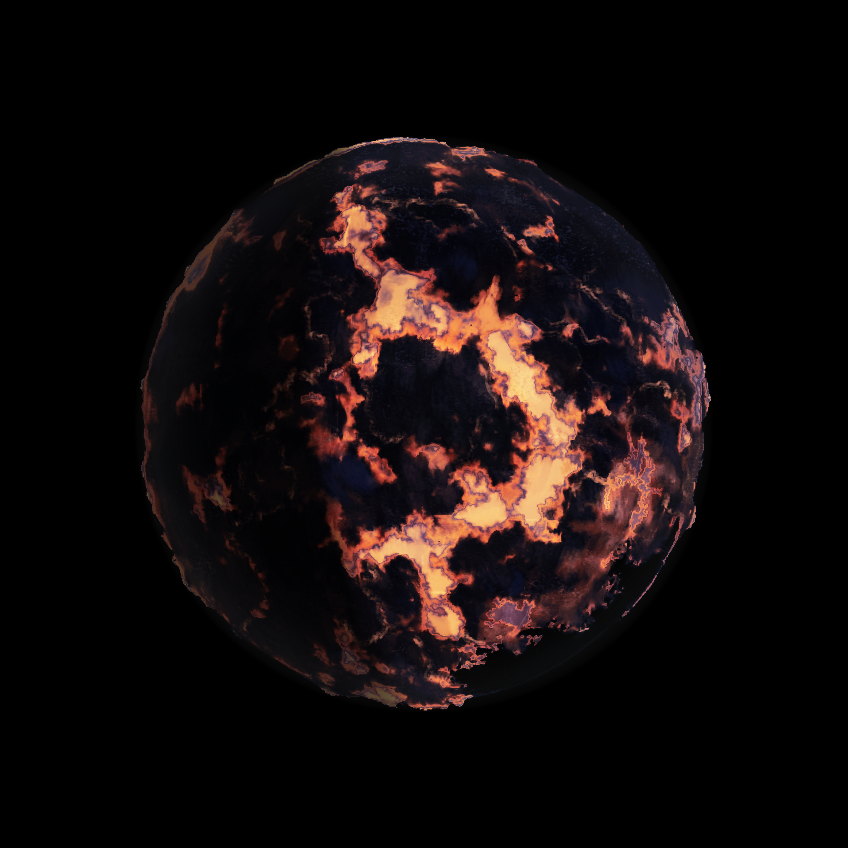
An artist's rendering of Vreneskej, if it were seen from space without its dense ash cloud layers.
|
|
| Classification | Volcanic terrestrial planet |
| Surface Water | ~20% |
| Orbital Period | ~640 days |
| Rotation Period | ~45 hours |
| Axial Tilt | ~18° |
| Star System | Unknown |
| Natural Satellites | Unknown |
| Sophonts | Matet |
| Population | ~10-15 million |
Vreneskej (/.vren.esˈkeɪ/ vren-es-KAY) or
Composition and structure
Vreneskej has a metallic core, a silicate mantle, and a thin crust composed of numerous small, fragmented continents. Much of the upper mantle is molten or partially molten.
The upper mantle undergoes a recurring cycle of melting, rising, cooling, then descending again. Different regions enter this cycle at different times, completing the cycle over the course of a season. The movement of the mantle continually fractures, melts, and renews the crust. The regularity of these cycles influences the movement and migration of life across the surface.
Gravity and magnetic field
Vreneskej has a high surface gravity. Its metallic core generates a strong magnetic field that protects the atmosphere from stellar radiation and charged particles. Movement within the planet causes the field to fluctuate, producing changes that are detectable at the surface but have little direct effect on life.
Orbit and rotation
Vreneskej has a 45-hour rotation period and takes roughly 640 days to complete an orbit around its star. Its axial tilt is approximately 18 degrees, producing seasonal changes in the amount of stellar radiation received. These changes are observable despite the inability to visually perceive the sun from the surface.
The year can be divided into eight seasons of roughly 80 days each, but different regions experience seasons asynchronously. A season is defined by recurring patterns of mantle activity rather than by changes in sunlight. These patterns vary between regions, but their regularity allows them to serve as a basis for local migrations and timekeeping.
Atmosphere and climate
The atmosphere traps much of the heat produced by the planet's interior. Geothermal activity is the primary source of surface heat, while stellar radiation serves a smaller contribution. Stellar light is scattered throughout the atmosphere, producing diffuse illumination across the planet. Any light reflected from the ground scatters and adds to this illumination.
Upper atmosphere
The upper atmosphere contains large quantities of ionized gas and suspended particulates. Stellar radiation and the magnetic field produce electrical activity throughout this region. Some of this activity produces visible storms, auroras, and other luminous atmospheric phenomena, which are common and visible from the surface.
Troposphere
The troposphere is the most dense region of Vreneskej's atmosphere. It is saturated with ash, dust, and aerosols produced by eruptions across the surface. These materials form an extensive, ever-present cloud layer. Strong convection and winds carry volcanic material through the atmosphere. Fine ash can remain suspended for long periods, while heavier materials return to the surface in ashfalls. The concentration and composition of atmospheric particles vary with local volcanic activity.
Weather and climate
Vreneskej has a hot climate with little variation in surface temperature. The dense atmosphere distributes heat across the surface, while geothermal activity provides a constant source of heat. Electrical storms occur throughout the planet and can develop far from active volcanic regions. Ashfalls are common, with the greatest concentrations occurring near active eruptions.
Hydrosphere
Vreneskej maintains a small, fraught hydrosphere, with liquid water covering just ~20 percent of the surface. Most surface water is concentrated in large lakes, inland basins, and smaller bodies scattered across the continents. The water is highly saline and mineral-saturated, often appearing black and opaque. High atmospheric pressure raises its boiling point, allowing this liquid water to persist despite the planet's surface temperatures. Evaporation, condensation, and precipitation form a continuous water cycle. Water is also present beneath the surface and within the crust. Subsurface water is heated by geothermal activity and returns to the surface through hot springs, vents, and geysers.
Biosphere
Life is concentrated around stable sources of water and geothermal activity, but organisms inhabit most regions of the surface. Regular mantle cycles influence the distribution and migration of life, with many species following predictable routes between regions as conditions change.
Plant life obtains energy through geothermal and chemical processes, using heat, volcanic compounds, and water as sources of nutrients. Most species are hard, dense, meaty, and rootlike, forming extensive patches of low brush. Plants reproduce through seeds and spores that are carried by wind currents. Underground structures allow some organisms to survive unfavorable conditions, so long as they are not subsumed back into the mantle, while new growths populate freshly risen regions. Some species possess limited physical mobility, allowing portions of the organism to reposition themselves or extend into new territory. Species that display more substantial movement do so dependant on the wind.
Most animal life is pseudo-insectoid, with body plans combining traits analogous to arthropods, crustaceans, mollusks, and cephalopods. The most common body plan involves exoskeletal plates covered by a flexible, skin-like membrane. Dynamic morphology is a common evolutionary development, allowing animals to actively alter the structure and configuration of their bodies. This can involve rearranging exoskeletal plates, organs, or soft tissues. The extent of this adaptation varies between species.
Another common adaptation is efficient telomere maintenance, allowing many species to avoid the progressive cellular aging associated with telomere shortening. Lifespans vary considerably between species, but long-lived animals are common. Matet represent an extreme example, with their effective telomere maintenance contributing to potentially indefinite lifespans. This comes at the expense of highly demanding metabolisms. Animals are required to consume large quantities of food to maintain their bodies and repair tissue. Insufficient replenishment results in rapid cell degradation and death.